Proof of what a learner can really do, not just a mark on a page.
A record of what each learner can do under the CBC, built from dated evidence, that teachers can keep up in class and parents can understand.
In development: the Android app works and is being prepared for a school pilot. The whole CBC, PP1 to Grade 12, is built in.
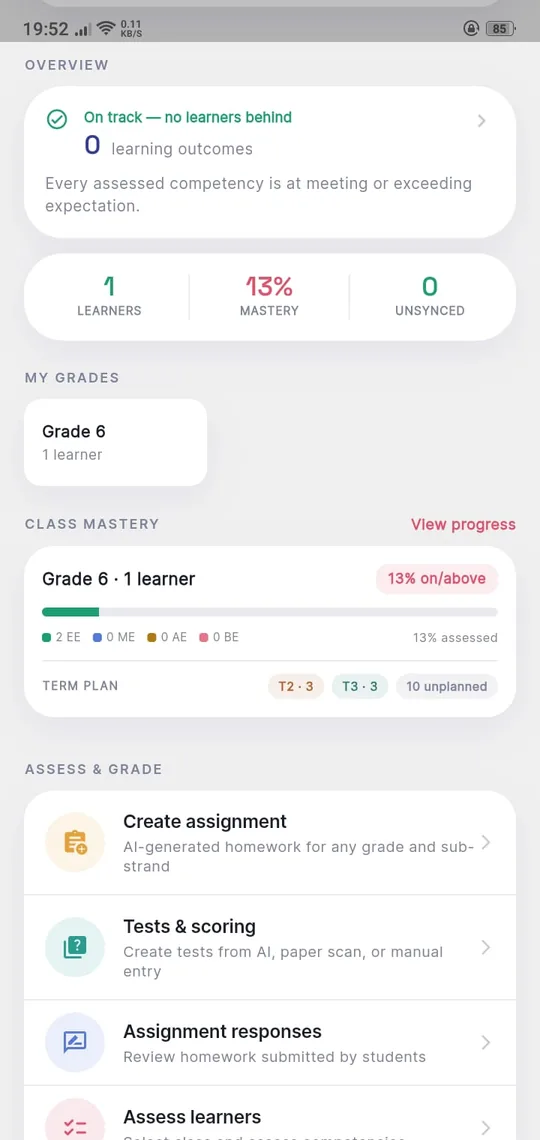
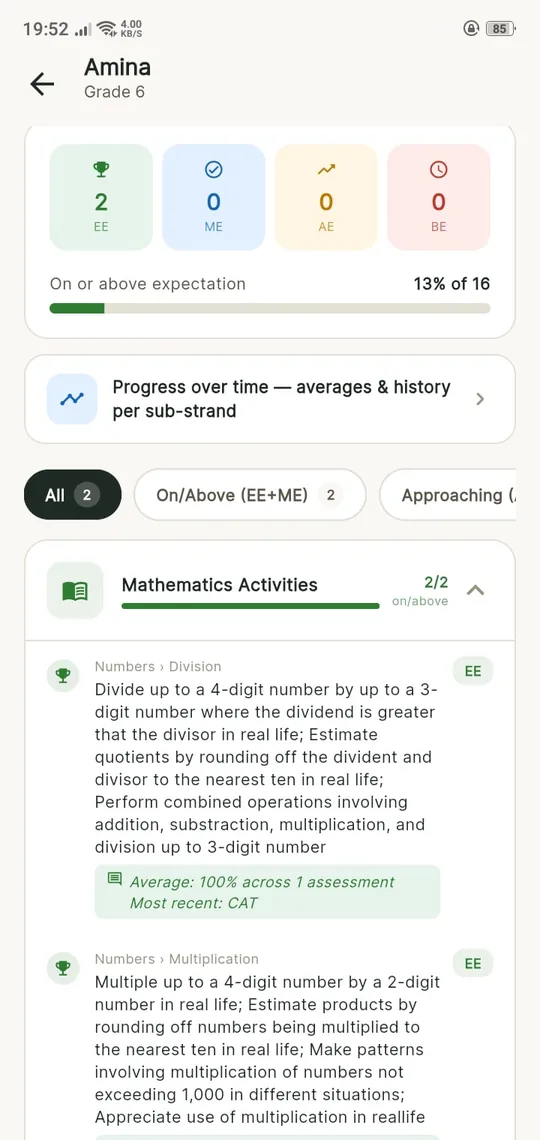
What it saves a teacher
Evidence-based records ask more of a teacher than a marks average. So Taalo puts the work into the app, not into evenings.
Evidence in one tap
A photo, a recording or a tap, tagged to the competency, with the date, how much help the learner had and the setting.
Tests made and marked
Generate assignments and tests for chosen sub-strands, or photograph a printed paper and the app reads it into questions. Mark question by question.
The paperwork, done
CBC records become a by-product of teaching: lesson progress against the suggested number of lessons, term planning and full dated histories.
A teacher's day with Taalo
Set up a class
Choose your grades and learning areas. Add learners one by one or import a class from a spreadsheet, and give each learner an access PIN. Several teachers can share a learner, each for their own learning areas.
Capture evidence as you teach
Photo, audio or video of a learner's work, or a classroom observation with an AI-drafted wording you accept or change.
Set and mark work
Daily assignments or tests, answered in the app or in exercise books. Multiple choice, short answer, true or false and show-your-working. Any question can be regenerated, and generated questions are checked before you see them.
Read the class
A dashboard per class, each learner's needs with the trend for every gap and the evidence behind it, and suggested activities for each learning outcome.
How a level is decided
The CBC asks: can this learner reliably do this, unaided, in more than one setting, right now? Taalo answers that question with four rules, applied to every learner every time.
Every piece of work is judged on its own
Each question, assignment and observation gets its own judgement. Nothing is blended into one score first.
What's recent matters most
Status comes from a learner's most recent evidence. Older results stay in the history but stop dragging today's status.
How much help was needed counts
Work done independently, with guidance or with heavy support is recorded as such. Heavily helped work can't count as meeting expectation.
One good day isn't enough
Meeting or exceeding needs evidence from at least two settings, such as a written test and a classroom observation.
A status moves up or down as evidence comes in, and there's no button to override it. A teacher records what happened; Taalo works out what it means. Where a status rests on one kind of evidence, it's flagged for a second look.
Why averaging scores can't work
Averages hide direction
40, 60, 90 and 90, 60, 40 average to the same number. One learner is thriving, the other needs help now.
One good task isn't proof
A right worksheet on counting money doesn't show the learner can count real coins at the market.
A right answer isn't always an independent one
A correct answer reached with heavy help isn't the same achievement as one reached alone.
Not everything is a score
The CBC values attitudes like enjoying sorting and grouping objects. You can't average your way to judging that.
For parents and learners
Parents get more than a report card they can't act on.
What my child can do
- A progress view opened with the learner's PIN
- In plain words, not codes or percentages
- Parents can add their own notes on a competency
What to do at home
- Suggested questions: what to practise at home
- What to celebrate
- The trend for each gap, so you know what's improving
What could come next
- A suggested senior-school pathway from the evidence: STEM, Social Sciences, or Arts and Sports Science
- With the reasons, so it's a conversation starter, not a verdict
Your learners' information
A school will ask this before anything else, so here it is first.
What Taalo keeps
A learner's name, gender, grade and learning areas, an access PIN, photos, audio and video of their schoolwork, marks, observations, and their competency history.
Never collected: date of birth, home address, identity numbers or health information.
Who can see it
Only the learner's teachers and their parent or guardian. Learners are added by their teacher or school with a parent's or guardian's agreement. Their information is used only for their education, never sold, never used for advertising, and never used to profile them for marketing.
AI helps draft questions, observations and summaries; it never decides a learner's level. Read the Taalo privacy policy.
Built honestly
Two things we're still improving, said plainly.
Questions are tagged by topic, not yet by exact skill
A topic area can cover several related skills, so test evidence lands in that broader pool until questions are tagged more precisely. That's next on the list.
One assignment shares one setting
So the two-settings rule mostly separates “tested” from “observed in class”, not different situations inside one test.
Where it stands
Works in the app
- Classes, evidence, assignments, tests, marking and competency status in the Android app
- Works offline; syncs and backs up when online; restore on a new phone
Before launch
- Ready for a first school pilot
- Cloud sync and backup being reviewed before any school data goes in
Planned
- Photograph a handwritten answer to draft an evidence entry
- Speak an observation to create an entry
- Assignments triggered by a gap in the evidence
- Tagging each question to the exact skill
- With consent, a learner's verified skills on an AOIS profile
Bring Taalo to your school.
We're looking for schools and teachers for the first pilot. Tell us about your school and the grades you teach.